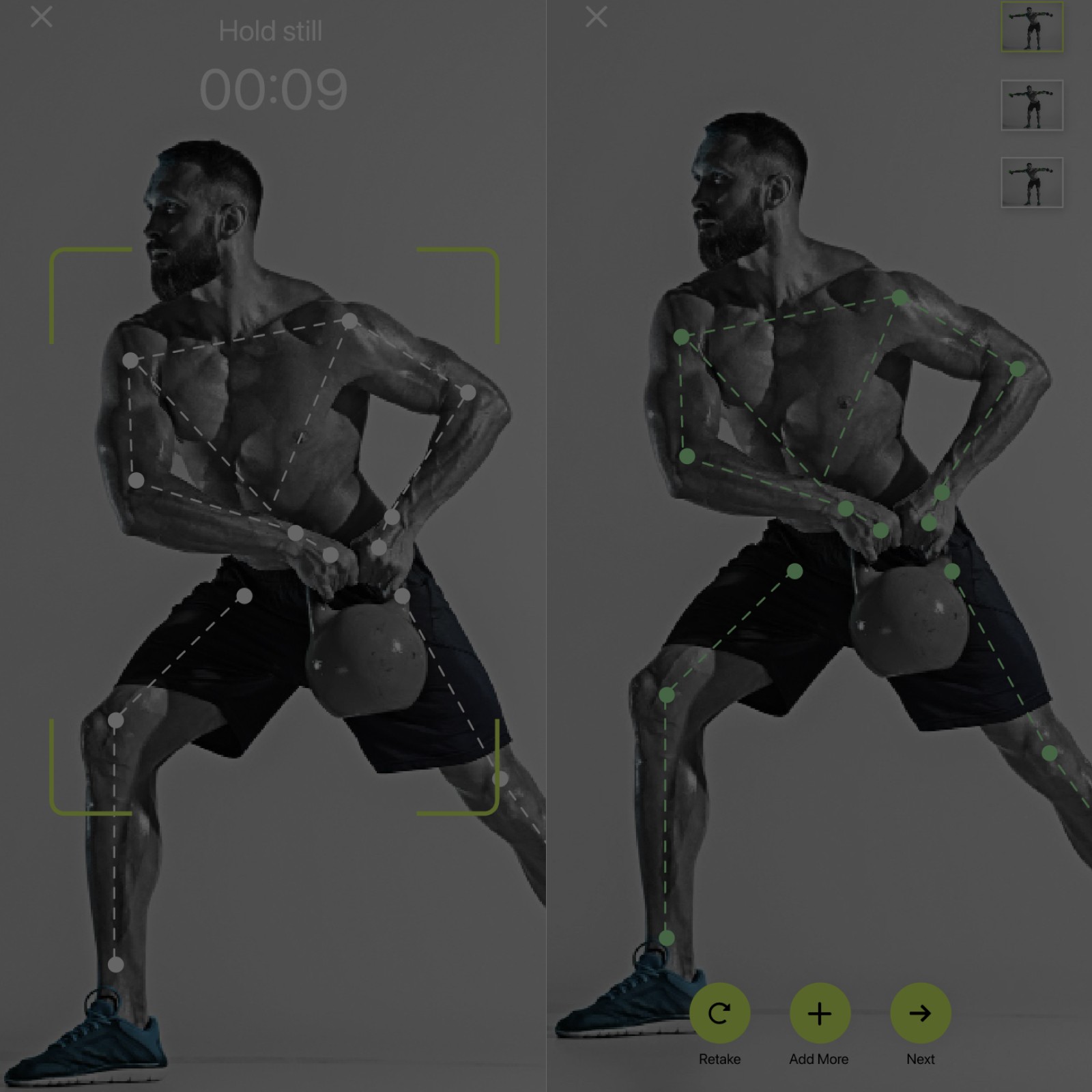
An iOS fitness app with two sides. Trainers record an exercise and its key poses once. Trainees learn it at home with AI pose recognition that turns green when their form matches and red when they need to adjust.
Client:
Confidential client · Europe
Role:
Senior UX Designer · team of 3
Platform:
iOS app · trainer and trainee sides

Context:
A fitness client in Europe wanted a small group of trainers it had selected to teach people who work out at home. The iOS app has two sides: trainers create workouts and the poses to perform, and trainees learn exercises based on their goal, with AI-based pose recognition checking their form. I was the senior UX designer in a team of three, in 2022.
Problem:
Trainers couldn’t video-call every customer to teach proper form. We had to find a way for trainers to upload an exercise once, so trainees at home would perform it exactly the way the trainer did.
Constraints:
Only trainers chosen by the client could publish exercises, and trainees would practise alone at home with no coach on the call. The feedback had to work without anyone watching.
Process:
1. Trainee onboarding: exercise preferences (activity level, how often they want to train, equipment) and a mobility and strength test that sets a starting level. 2. Trainer tools: weekly plans by goal and level, exercises by body part and equipment, a short demo video, and the key poses captured for one repetition. 3. Pose matching: before and during a set, the camera tracks the trainee’s body against the trainer’s poses. 4. Progress: test results, daily sessions with set tracking, and a weekly summary.
Decision:
Keep the trainer’s side to recording: one demo video and the key poses for a single repetition, captured with a pose-mapping camera. Give trainees simple, instant feedback instead: the tracked pose turns green when it matches so they can carry on, and red when they need to adjust.
Outcome:
Hundreds of users learned exercises at home at their own pace, and found it easy, without feeling judged by a trainer on camera. Trainers could take on more customers because they no longer had to coach each one over video.